
By Nancy Becher, Founder & Executive Director, Invisible Warriors
There’s a conversation happening inside the largest veterans organizations in America right now. You won’t hear it in their press releases. You’ll hear it from the post commanders — the people close enough to the problem to speak plainly about it.
One of them put it this way: “If we don’t bring in the younger generation, if we don’t have these people, then the American Legion doesn’t survive.”
He’s right. And the national leadership mostly responds with careful language about external factors (smaller military, aging membership, demographics) rather than asking the harder question: Why haven’t we given the next generation of veterans a reason to show up?
I’m not writing this to pile on organizations that have done real and important work. I’m writing this because Invisible Warriors was built in the space that answer creates.
The Gap No One Wants to Name
The VFW and American Legion were built for a specific era of veteran. The World War II veteran who came home, joined the post down the street, and found community around shared service. That model worked because the world it was built for was cohesive: same war, same generation, same cultural moment.
The post-9/11 veteran exists in a different world entirely.
Less than 1% of Americans serve. That means most veterans come home to communities where almost no one around them has shared that experience. The isolation isn’t a feeling: it’s a structural reality. And an organization built around a physical post in a town where veterans already knew each other doesn’t solve that problem. It replicates it at a smaller scale.
What the data shows — membership in free fall, posts consolidating or closing, the oldest members holding the whole thing together — isn’t a surprise. It’s the outcome of applying a 20th-century model to a 21st-century reality and calling the gap a “challenge.”
"It's the outcome of applying a 20th-century model to a 21st-century reality and calling the gap a 'challenge.'"
What We’re Building Instead to Support Women Veterans
Invisible Warriors isn’t a post. We’re not a membership drive. We’re not asking veterans to show up to a building on Thursday nights and hope that community happens.
We’re building something different: a connection that meets veterans where they are.
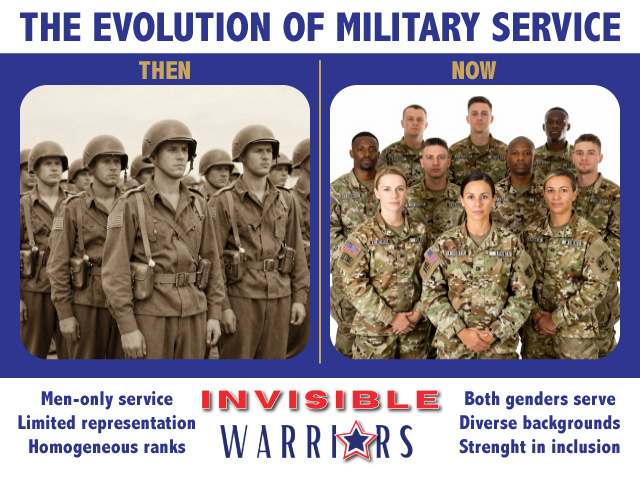
That means online and in-person. It means programs designed around the specific experience of women veterans: a population that the legacy organizations have historically underserved, underrepresented, and in some cases actively excluded. It means acknowledging that the barriers veterans face aren’t just about benefits and bureaucracy. They’re about belonging. About being seen. About finding people who understand what you carry without having to explain it first.
The name says it. Invisible Warriors. We exist because there is a population of veterans who are disproportionately women, disproportionately from recent conflicts — and who have been doing hard, real, consequential things in service to this country, and coming home to find that the systems built to support veterans weren’t quite built for them.
We’re not trying to replace what the legacy organizations do well. We’re filling the space they left.
Honest About What This Takes
The veterans who need what we’re building aren’t going to be reached by comfortable language.
They’re not going to show up because we sent a press release. They’re going to show up because someone they trust told them: this is real, these people see you, this is worth your time.
That’s a harder thing to build than a membership drive. It requires trust, and trust takes time. It requires showing up consistently, following through, making people feel that when they reach out, someone is actually on the other side.
It also requires honesty about what we are and what we’re still becoming. We’re a young organization. We’re growing. We don’t have the infrastructure of organizations that have been doing this for a hundred years. What we have is clarity of purpose and a genuine commitment to building something that works for the veterans who are actually here — not the ones who existed in 1945.
"The warriors who've been invisible long enough deserve to be seen. That's what we're here for."
Why This Moment Matters
The veterans who served in Iraq and Afghanistan are aging into the years when the need for community and connection becomes most acute. The window to reach them — before the isolation compounds, before the distance from service becomes too great, before the assumption sets in that there’s nothing out there for them — is not infinite.
The organizations that could have served them have, in many cases, failed to adapt quickly enough. That’s not a condemnation. It’s an observation. And it creates an opening.
Invisible Warriors exists in that opening. We intend to use it.
If you’re a veteran looking for something that doesn’t feel like it was designed for someone else’s experience — we’re here.
If you’re someone who cares about veterans and wants to support women veterans through an organization that’s doing this work honestly and from the ground up, we’d love to have you.
The warriors who’ve been invisible long enough deserve to be seen. That’s what we’re here for.
Nancy Becher is the Founder and Executive Director of Invisible Warriors, a nonprofit dedicated to building community and connection for veterans (especially those who have felt unseen by traditional support systems). Learn more at invisiblewarriors.org.
Want to know more about Invisible Warriors? Sign up for our newsletter to receive regular updates. Contact us HERE.
Or click the button below to schedule a meeting with Founder Nancy Becher!